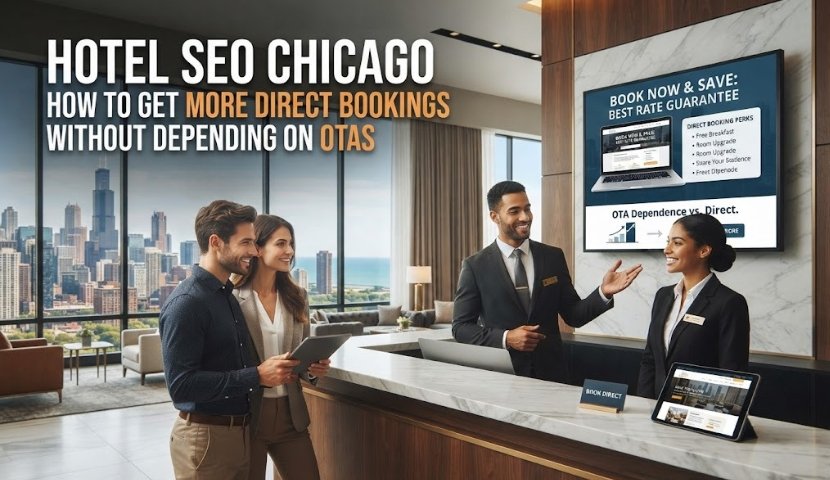
If you manage a hotel in Chicago, you already know how easy it is to become dependent on online travel agencies.
A traveler searches for a hotel.
They see dozens of options on an OTA.
They compare prices.
They read reviews.
They click.
And eventually, your hotel gets the booking—but a portion of the revenue goes to a third-party platform.
OTAs can absolutely be useful. They put hotels in front of travelers who may never have discovered them otherwise.
But here’s the bigger question:
What would happen if more travelers booked directly through your hotel website?
More control over the guest relationship.
More opportunities to build loyalty.
More opportunities to upsell.
And potentially less dependence on third-party booking channels.
That’s where Hotel SEO Chicago becomes important.
A strong hotel SEO strategy isn’t simply about ranking your homepage on Google. It’s about making your hotel visible when travelers are searching, answering their questions before they book, building trust, and giving them a compelling reason to visit your website instead of clicking somewhere else.
Why Direct Bookings Matter for Chicago Hotels
Chicago’s hotel market is incredibly competitive.
You’ve got downtown hotels competing for business travelers and tourists, boutique properties competing on experience, airport hotels competing on convenience, and suburban hotels competing for families, corporate travelers, weddings and events.
Meanwhile, OTAs can place all of these properties next to each other in search results.
That’s convenient for travelers.
But it can make it difficult for an individual hotel to build a direct relationship with the customer.
Your website should therefore do more than display rooms.
It should answer:
Why should I stay here?
Why is this location convenient?
What amenities do you offer?
What’s nearby?
Is parking available?
Do you offer breakfast?
Are you pet-friendly?
Do you have meeting or event space?
Can I get a better value by booking directly?
The more effectively your website answers these questions, the more useful it becomes during the traveler’s decision-making process.
Start With the Searches Travelers Actually Make
A common SEO mistake is trying to rank for one enormous keyword:
“Hotels in Chicago.”
It’s incredibly competitive.
And it isn’t necessarily the only search that matters.
Travelers have different intentions.
Someone might search:
- Hotels near downtown Chicago
- Hotels near McCormick Place
- Chicago hotel near O’Hare
- Boutique hotels Chicago
- Family-friendly hotels Chicago
- Hotels near Navy Pier
- Chicago hotels with parking
- Hotels near United Center
- Chicago hotel with meeting rooms
- Affordable hotels in Chicago
These searches tell you something important:
Travelers don’t just search for hotels. They search for hotels that solve a specific need.
That’s where a smarter SEO strategy starts.
Create Landing Pages Around What Guests Actually Want
Suppose your hotel is near McCormick Place.
Instead of relying entirely on your homepage, you could create a dedicated page around:
Hotels Near McCormick Place Chicago
That page could explain your distance from the convention center, transportation options, parking, business amenities, meeting facilities and nearby restaurants.
Or perhaps your hotel attracts families.
A useful page could focus on:
Family-Friendly Hotel in Chicago
It could explain room options, nearby attractions, breakfast, parking and family-friendly activities.
These pages aren’t just SEO tools.
They’re sales pages designed around traveler intent.
Your Location Is One of Your Biggest Marketing Assets
Hotels have something many businesses don’t:
Location is part of the product.
Don’t hide it.
If you’re close to major Chicago attractions, neighborhoods, hospitals, universities, convention centers, airports, restaurants or sports venues, make that information easy to find.
Create useful content around the locations your guests care about.
For example:
“Where to Stay Near McCormick Place for a Chicago Convention”
“Best Things to Do Near Our Chicago Hotel”
“How to Get From O’Hare to Our Hotel”
“Hotels Near United Center: What Visitors Should Know”
“Chicago Weekend Itinerary From Our Hotel”
These pages can attract travelers before they’ve decided where to stay.
That’s the power of content-driven hotel SEO.
Google Maps Matters for Hotels
Imagine a traveler searching:
“hotel near me.”
Google Maps and local search results can become extremely important.
Your Google Business Profile should accurately communicate your hotel name, location, phone number, website, amenities and other relevant information.
Your photos matter.
Your reviews matter.
Your website matters.
Your consistency across online platforms matters.
Local SEO and traditional SEO shouldn’t be treated as separate worlds.
They should support one another.
Reviews Can Influence the Booking Decision
A traveler might find your hotel through Google.
Then they see your reviews.
Suddenly, your 4.4-star rating is being compared with another property’s 4.7.
They read the comments.
They look at recent experiences.
They check what guests say about cleanliness, service, rooms, location and staff.
This is why reputation management should be part of hotel marketing.
Hotels should actively monitor reviews, respond professionally, learn from recurring feedback and make it easy for satisfied guests to share genuine experiences.
You can’t control every review.
But you can control how you respond and how consistently you deliver the experience behind those reviews.
Your Website Needs to Make Direct Booking Easy
Here’s an important question:
If someone wants to book directly, how many clicks does it take?
If a visitor has to hunt for your booking button, search through confusing menus or leave your website to figure out availability, you’ve created unnecessary friction.
Your website should make the booking path obvious.
Find a room → Check availability → Choose room → Book
Simple.
Your website should also clearly communicate the value of booking directly where appropriate.
That could include direct-booking benefits such as:
- Exclusive offers
- Flexible policies
- Loyalty benefits
- Special packages
- Complimentary amenities
- Direct customer support
The specific offer depends on the hotel’s business model.
The important thing is giving the customer a reason to consider booking directly.
Don’t Forget Mobile Search
Travelers aren’t always sitting at a desktop computer planning a trip.
They may be standing at an airport.
Sitting in a rideshare.
Walking around downtown Chicago.
Planning dinner.
Looking for a last-minute room.
Your hotel website needs to work exceptionally well on mobile devices.
That means:
Fast loading.
Easy navigation.
Large, obvious booking buttons.
Readable room information.
Simple forms.
Easy-to-find phone numbers.
Mobile SEO isn’t just a technical exercise.
It’s part of the guest experience.
Hotel Content Should Answer Questions, Not Fill a Blog Calendar
A hotel doesn’t need 50 generic blog posts about travel.
It needs useful content that helps potential guests make decisions.
Think about questions travelers actually ask:
Where should I stay in Chicago for a convention?
What hotels are near Navy Pier?
How much does parking cost at Chicago hotels?
What’s the best area to stay in Chicago for families?
How do I get from O’Hare to downtown Chicago?
What can I do near my Chicago hotel?
Each question represents a potential search.
Each search represents a potential traveler.
And each traveler represents a potential booking.
What About AI Search?
Hotel discovery is also becoming more conversational.
Travelers can ask AI assistants:
“What’s a good hotel in Chicago for a family visiting for three days?”
“Recommend hotels near McCormick Place with convenient transportation.”
“Which Chicago hotels are good for business travelers?”
The answer may summarize several properties instead of showing a traditional list of links.
That’s why hotels should start thinking about AI Search Optimization (GEO) alongside traditional SEO.
AI systems need clear information to understand a hotel.
Your website should clearly communicate your location, amenities, room types, guest experience, nearby attractions, services and unique selling points.
Your broader online presence should reinforce the same information.
The objective isn’t to “trick AI into ranking your hotel.”
It’s to build a digital presence that is clear, trustworthy, comprehensive and easy to understand.
Don’t Try to Eliminate OTAs—Build a Better Balance
This is important.
The goal isn’t necessarily to stop using OTAs.
They can introduce your hotel to new travelers.
The smarter goal is to avoid becoming completely dependent on them.
Think of your distribution strategy as a mix:
OTAs → New customer discovery
Google → Search visibility
SEO → Long-term organic traffic
Social media → Brand awareness
Email → Guest retention
Hotel website → Direct bookings
The stronger your owned channels become, the more control you have over your customer relationships.
How Chicago Tech Solutions Can Help Hotels
Hotel SEO requires more than inserting “Chicago hotel” into a homepage.
It requires an integrated digital strategy.
Chicago Tech Solutions can help hospitality businesses with:
- SEO
- Local SEO
- Hotel website development
- Content marketing
- PPC advertising
- Social media marketing
- Reputation management
- AI Search Optimization
- Conversion optimization
- Branding
- Printing services
The goal is to connect the entire customer journey.
Search → Website → Trust → Booking → Guest Experience → Review → Repeat Visit
And when these pieces work together, your hotel has a much stronger digital foundation.
Your Next Guest Is Already Searching
Someone is searching for a hotel in Chicago right now.
They may be planning a convention.
A weekend getaway.
A family vacation.
A business trip.
A wedding.
A sporting event.
Or simply a last-minute stay.
The question isn’t whether travelers are searching.
It’s whether your hotel is visible when they do.
And when they find you, the next question is even more important:
Can your website convince them to book directly?
That’s where hotel SEO stops being about rankings and starts becoming about revenue.
Ready to Get More Direct Hotel Bookings?
If your Chicago hotel relies heavily on OTAs and wants to strengthen its direct booking strategy, Chicago Tech Solutions can help evaluate your website, search visibility, local presence and digital customer journey.
Because the ultimate goal isn’t simply to rank higher.
It’s to turn more searches into direct guests.
Frequently Asked Questions
What is hotel SEO?
Hotel SEO is the process of optimizing a hotel’s website and online presence to improve visibility when travelers search for accommodations, locations, amenities, attractions and travel-related services.
Can SEO help hotels get more direct bookings?
Yes. SEO can bring qualified organic traffic to hotel websites. When combined with strong landing pages, compelling content, clear booking paths and effective conversion optimization, that traffic can contribute to more direct bookings.
How can a Chicago hotel rank on Google?
Hotels can target relevant location and intent-based searches, optimize their website, strengthen Local SEO, maintain an accurate Google Business Profile, create useful travel content, build authority and maintain a strong online reputation.
What keywords should Chicago hotels target?
Potential opportunities include Chicago hotels, hotels near downtown Chicago, hotels near McCormick Place, hotels near O’Hare, Chicago hotels with parking, family-friendly hotels Chicago and other searches based on the hotel’s location and target guests.
Should hotels stop using OTAs?
Not necessarily. OTAs can provide valuable exposure and new customers. The better strategy is often to balance OTA bookings with direct bookings generated through SEO, paid search, email, social media and the hotel’s own website.
How important are Google reviews for hotels?
Reviews can significantly influence traveler decisions. Hotels should monitor reviews, respond professionally and consistently encourage genuine feedback from guests.
Does hotel website design affect bookings?
Yes. Slow loading speeds, poor mobile experiences, confusing navigation and difficult booking processes can create friction. A hotel website should make it easy for travelers to find information and complete the booking process.
What is AI Search Optimization for hotels?
AI Search Optimization, or GEO, focuses on making hotel information easier for AI-powered search systems to understand when travelers ask conversational questions and request recommendations.
Can Chicago Tech Solutions help with hotel SEO?
Yes. Chicago Tech Solutions provides SEO, Local SEO, website development, content marketing, PPC, reputation management, AI Search Optimization and other digital marketing services for businesses looking to strengthen their online visibility.