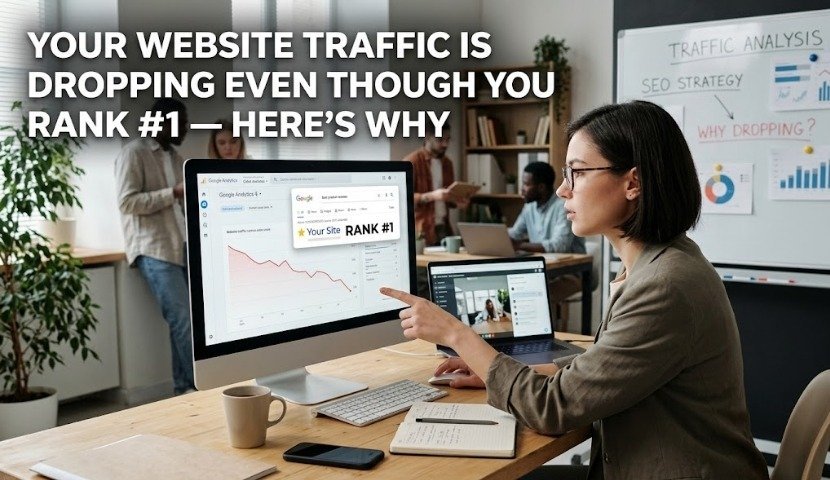
If you’ve checked Google Search Console lately and noticed impressions holding steady while clicks quietly slide, you’re not imagining it and you’re not doing anything wrong. This is happening across the board in 2026, and it has a specific cause: Google is answering questions directly on the search results page before people ever reach your site.
It’s called zero-click search, and it’s the single biggest change to how search works since Google introduced featured snippets over a decade ago. Here’s what’s actually going on, and — more importantly — what a business can still do about it.
The Numbers Are Bigger Than Most People Realize
As of early-to-mid 2026, AI Overviews now appear on roughly 48% of Google search results, up sharply year over year. When an AI Overview shows up above the traditional results, organic click-through rate drops by somewhere between 34% and 61%, depending on the study. For queries that trigger Google’s more aggressive “AI Mode,” the numbers get even starker — a large majority of those sessions end without a single click to any external website.
For businesses that lean heavily on informational content — how-to guides, explainers, definitions — the impact has been direct and measurable. Some publishers tracking this closely have reported traffic declines in the 40–70% range on the specific pages Google now answers itself.
Why This Is Happening
Google’s AI Overview pulls information from multiple sources, synthesizes it into a short answer, and places it at the top of the results page — often with a citation link at the bottom that most users never click. If someone searches “how to size a banner for a trade show booth,” they used to have to visit a website to get that answer. Now Google can just tell them, right there on the results page.
This isn’t unique to Google, either. A growing share of people are skipping search altogether and asking ChatGPT, Gemini, or Perplexity directly — meaning some of your potential traffic never even touches a Google search bar in the first place.
The Important Nuance: It’s Not Evenly Distributed
Before you panic and rewrite your entire content strategy, it’s worth knowing that this trend hits some types of content far harder than others:
- Hit hardest: Generic how-to guides, definitions, broad educational explainers — the “what is X” and “how do I do X” content that Google can easily summarize itself.
- Hit moderately: Comparison pages, “best X for Y” roundups.
- Barely touched: Transactional and commercial-intent searches. E-commerce and “buy X near me” style queries trigger AI Overviews far less often, because Google has found that AI answers don’t convert well for purchase-intent searches.
In other words, if your content strategy has been leaning on generic educational blog posts to drive traffic, you’re in the blast radius. If it’s built around local service pages, pricing, comparisons, and case studies, you’re much better insulated.
What Actually Still Works
1. Get cited, not just ranked. Brands that are cited inside an AI Overview see meaningfully higher click-through rates than brands that aren’t cited at all on the same query. Being the source Google pulls from is now more valuable than ranking #1 in a set of blue links nobody clicks. This means writing clear, direct, well-structured answers to specific questions — the same principle behind AI-search (GEO) optimization generally.
2. Shift toward content Google can’t easily summarize. Original data, case studies with real numbers, first-person operational insights, and named local examples are harder for an AI Overview to compress into three sentences. A generic “5 tips for choosing a printer” post is exposed. “We printed 3,200 EDDM postcards for a local landscaping company and here’s exactly what happened” is not.
3. Build owned channels you don’t have to win over Google to keep. Email lists, SMS, and returning customers don’t depend on a search algorithm. If organic search traffic is becoming a less reliable acquisition channel, the businesses that will be fine in 2027 are the ones building direct relationships with their audience now, not relying entirely on new visitors from Google.
4. Double down on local and transactional pages. Since AI Overviews show up far less often on purchase-intent and local searches, your service pages, location pages, and pricing pages are safer ground to invest in than broad educational content.
5. Keep content fresh. Pages that are updated regularly are significantly more likely to keep their AI citations than pages left untouched for a year or more. Quarterly reviews of your top content are no longer optional housekeeping — they’re a ranking factor.
What This Doesn’t Mean
It doesn’t mean stop blogging, and it doesn’t mean SEO is dead. Search is still the highest-ROI marketing channel available to most businesses, and being cited by an AI Overview is still free exposure with your brand name in front of a motivated searcher. What’s changed is the goal: the blog post’s job is no longer purely “get a click.” It’s now “build authority Google trusts, get cited, and support the pages that actually convert.”
If you’re seeing impressions hold steady while clicks fall, that’s the classic signature of zero-click search eating into your traffic — not a sign your content or your SEO has gotten worse.
Chicago Tech Solutions can pull your Search Console data, show you exactly which pages are losing clicks to AI Overviews, and rebuild your content plan around what still works in 2026. Let’s take a look at your numbers.
FAQs
What is zero-click search? Zero-click search refers to a search query that gets answered directly on the results page — through an AI Overview, featured snippet, or other on-page feature — without the user clicking through to any website.
Why is my organic traffic dropping even though my rankings haven’t changed? This is the classic sign of AI Overviews or other zero-click features intercepting clicks. Check Google Search Console: if impressions are stable but clicks are falling, your rankings are fine — the click-through behavior has changed instead.
Which types of content are most affected by AI Overviews? Generic informational content — how-to guides, basic definitions, broad explainers — is hit hardest, since it’s the easiest for Google to summarize directly. Local service pages, pricing pages, and purchase-intent content are far less affected.
Should I stop writing blog content because of zero-click search? No. Blog content still builds authority, earns AI citations, and supports the pages that actually convert. What should change is the type of content you prioritize — favor original data, case studies, and specific local examples over generic explainers.
How can I tell if Google is citing my content in an AI Overview? Some SEO tools now flag which of your keywords trigger an AI Overview and whether your site is cited. You can also manually check by searching your target queries and seeing whether your business appears as a cited source.
Does zero-click search affect local businesses the same way it affects large publishers? Not evenly. Large publishers relying on broad informational traffic have been hit hardest. Local businesses with strong location and service pages, and purchase-intent keywords, tend to be more insulated, since AI Overviews appear far less often on those types of searches.