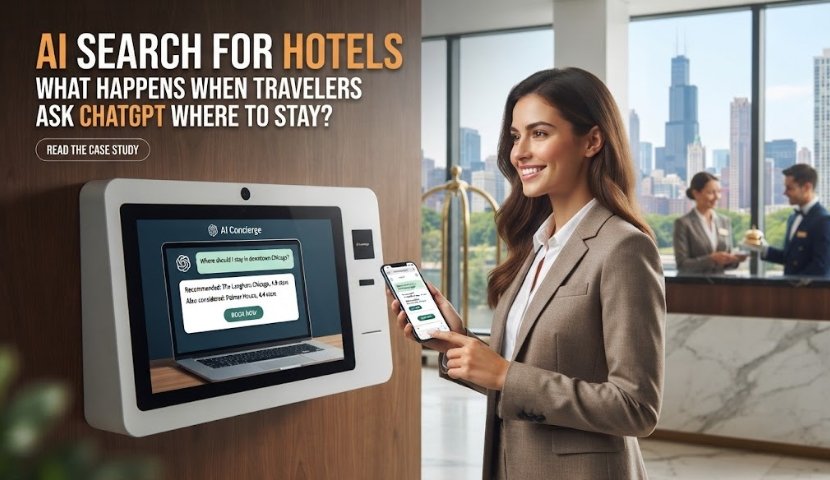
A traveler lands in Chicago, opens an AI assistant and types:
“Where should I stay in Chicago for a three-day trip?”
They aren’t necessarily looking for a list of ten blue links.
They want an answer.
Maybe they want a hotel near downtown. Maybe they’re traveling with family. Maybe they’re attending a convention at McCormick Place. Maybe they need parking, breakfast, pet-friendly rooms or easy access to O’Hare.
And this is where hotel marketing is entering a new era.
For years, hotels focused heavily on ranking on Google for searches like “Chicago hotels” or “hotels near downtown Chicago.”
Those searches still matter.
But now there is another question hotel owners need to consider:
What happens when travelers ask AI where to stay?
That question is becoming increasingly important for hotels competing for bookings in Chicago and other major travel markets.
Travelers Are Searching Differently
Traditional search might look like:
“Best hotels in Chicago.”
AI search can sound more like:
“I’m visiting Chicago for three days with my family. We want to be close to attractions, have a comfortable hotel and avoid spending too much on transportation. Where should we stay?”
That’s a completely different kind of search.
The traveler has provided:
- Destination
- Trip duration
- Group type
- Preferences
- Budget considerations
- Transportation concerns
- Desired experience
They’re not simply asking for a keyword match.
They’re asking for a recommendation based on context.
And that changes how hotels should think about their online presence.
What Does AI Actually Need to Know About Your Hotel?
Imagine an AI system trying to determine whether your hotel is relevant to a traveler’s question.
It needs to understand your business.
Not just your name.
Not just your address.
It needs context.
For example:
Where are you located?
What type of hotel are you?
Who are your typical guests?
What amenities do you offer?
Are you family-friendly?
Do you offer parking?
Are you near major attractions?
Are you convenient for business travelers?
Do you have meeting or event facilities?
What do guests say about their experience?
What makes your hotel different from competitors?
The clearer this information is across your digital presence, the easier it is for search systems—and potential customers—to understand what your hotel offers.
That’s where AI Search Optimization, often discussed alongside Generative Engine Optimization (GEO), comes into the conversation.
AI Search Isn’t Just About Keywords
Traditional SEO often starts with keyword research.
That’s still important.
But hotel businesses should think beyond individual keywords.
Consider the difference:
Keyword:
“Chicago hotel”
Question:
“What are good Chicago hotels for a family visiting Navy Pier?”
The second query contains much more intent.
A strong hotel website should contain useful information that answers these kinds of questions naturally.
For example, instead of simply saying:
“We are a Chicago hotel.”
Your website might clearly explain your proximity to attractions, transportation options, room types, amenities and the types of travelers your property serves.
You’re not writing for an algorithm.
You’re helping a traveler make a decision.
And that’s increasingly important in AI-driven search.
Your Hotel Website Is Your Digital Salesperson
Think about your website differently.
It isn’t just an online brochure.
It’s working 24/7 to answer questions from potential guests.
A traveler may want to know:
- How far is the hotel from downtown?
- Is parking available?
- Is breakfast offered?
- Are there family rooms?
- Are pets allowed?
- How close is the hotel to public transportation?
- Is the hotel near McCormick Place?
- How far is it from O’Hare?
- What attractions are nearby?
- Does the hotel have meeting space?
- Can I book directly?
If your website doesn’t answer these questions, customers may look elsewhere.
And when they ask AI for recommendations, the information available across your digital footprint becomes even more important.
Local Information Can Become a Competitive Advantage
For hotels, location is part of the product.
A hotel near McCormick Place has a different value proposition from a hotel near O’Hare.
A boutique hotel in River North has a different audience from a suburban property.
A hotel near Wrigley Field may attract sports fans.
A property near the Magnificent Mile may attract leisure travelers and shoppers.
Your marketing should make those distinctions obvious.
Instead of trying to be everything to everyone, create content around the audiences and locations that matter to your business.
For example:
Hotels Near McCormick Place
Create useful content explaining transportation, convention access, dining options and business amenities.
Hotels Near Chicago Attractions
Create guides covering nearby attractions, transportation and suggested itineraries.
Family-Friendly Chicago Hotels
Explain room options, nearby family attractions, dining and convenience.
Chicago Hotels for Business Travelers
Highlight Wi-Fi, meeting facilities, workspace, transportation and proximity to business districts.
These pages can serve both travelers and search engines.
Reviews Could Matter More Than Ever
Imagine asking an AI assistant:
“What Chicago hotels have good guest reviews and are convenient for families?”
The quality and reputation of a hotel suddenly become highly relevant.
Reviews provide something a hotel website can’t fully manufacture:
customer experience signals.
Guests talk about:
- Cleanliness
- Staff
- Rooms
- Location
- Breakfast
- Parking
- Service
- Comfort
- Value
Hotels should therefore treat reviews as a core part of their digital marketing strategy.
Monitor them.
Respond professionally.
Learn from recurring feedback.
And encourage genuine guests to share their experiences.
A strong reputation helps potential guests feel more confident when choosing where to stay.
Don’t Ignore Google
AI search doesn’t mean traditional search has disappeared.
Far from it.
Many travelers will still discover your hotel through:
Google Search
Google Maps
Hotel search platforms
Social media
Review websites
Travel websites
Your own website
AI is another layer in an increasingly complex discovery journey.
That’s why hotels shouldn’t abandon traditional SEO.
Instead, they should build a broader strategy that includes:
SEO + Local SEO + Content + Reputation + Website UX + AI Search Optimization
Think of it as building a stronger digital ecosystem rather than chasing one particular platform.
Direct Bookings Still Matter
Here’s another important part of the conversation.
Suppose AI recommends your hotel.
Great.
But where does the traveler go next?
Ideally, they should be able to find your official website quickly and book.
This is where AI search and direct-booking strategy intersect.
Your website should make it easy to:
Understand the property → Compare rooms → See amenities → Check availability → Book
If the website experience is confusing, slow or difficult to navigate, all that visibility can be wasted.
The goal isn’t simply:
“Get recommended by AI.”
The goal is:
“Get discovered, trusted and booked.”
What Can Chicago Hotels Do Right Now?
You don’t need to completely rebuild your marketing strategy overnight.
Start with the basics.
1. Make Your Hotel Information Consistent
Your hotel name, address, phone number, website, amenities and other important information should be accurate across relevant platforms.
2. Strengthen Your Website
Make sure your website clearly explains your rooms, amenities, location, nearby attractions and booking options.
3. Build Useful Local Content
Create pages and articles answering questions travelers actually ask.
4. Improve Your Local SEO
Optimize your Google Business Profile and other relevant local listings.
5. Build Your Reputation
Encourage genuine reviews and respond professionally to guest feedback.
6. Think in Questions, Not Just Keywords
Instead of asking:
“What keyword should we rank for?”
also ask:
“What questions does our ideal guest ask before booking?”
Then create genuinely useful answers.
7. Make Your Website Easy for AI and Humans to Understand
Use clear headings, descriptive content, structured information and straightforward navigation.
Good information architecture helps people first—and can also make your content easier for search systems to interpret.
What Does This Mean for Hotel Marketing Agencies?
Hotel marketing is no longer just about ranking a webpage.
A modern hotel digital marketing agency needs to understand the entire discovery journey.
A potential guest might:
Ask AI → Search Google → Check Maps → Read reviews → Visit Instagram → Visit hotel website → Compare options → Book
That’s a lot of touchpoints.
Your marketing strategy needs to connect them.
This is where Chicago Tech Solutions can help hotels combine:
- Hotel SEO
- Local SEO
- Website development
- Content marketing
- PPC
- Social media marketing
- Reputation management
- AI Search Optimization
- Conversion optimization
- Branding
- Printing services
Instead of treating every channel as a separate activity, the goal is to create one connected customer journey.
The Future Hotel Search May Sound More Like a Conversation
The biggest change isn’t necessarily that people are using AI.
It’s how they’re using it.
Instead of typing:
“Chicago hotels.”
They can ask:
“I’m coming to Chicago with my parents for four days. Which areas should we stay in if we want to visit the main attractions without spending too much time traveling?”
That’s a much richer question.
Hotels that clearly communicate their location, experience, amenities, audience and value proposition will have a stronger foundation for competing in this new search environment.
And here’s the important part:
You don’t need to write content for robots.
Write useful content for travelers.
Answer real questions.
Provide accurate information.
Make your website trustworthy.
Build a strong reputation.
Make booking easy.
That’s good SEO.
That’s good AI Search Optimization.
And most importantly, that’s good hospitality marketing.
When Travelers Ask AI Where to Stay, Will Your Hotel Be Ready?
The hotel industry has always competed for visibility.
First it was travel guides.
Then search engines.
Then OTAs.
Then social media.
Now AI-powered search is becoming another way travelers discover where to stay.
The hotels that adapt early have an opportunity to build visibility before the market becomes even more competitive.
So don’t just ask:
“How do we rank on Google?”
Start asking:
“How do we become the hotel travelers—and AI-powered search—can easily understand, trust and recommend?”
That’s the next chapter of hotel marketing.
And Chicago hotels that start preparing now will be in a much stronger position when the next traveler asks:
“ChatGPT, where should I stay in Chicago?”
Frequently Asked Questions
Can ChatGPT recommend hotels?
AI assistants can provide travel recommendations based on the information available to them and the context provided in a user’s question. However, recommendations can vary, and hotels should not assume that optimization guarantees inclusion in an AI response.
What is AI Search Optimization for hotels?
AI Search Optimization focuses on making a hotel’s online information clear, comprehensive, trustworthy and easy for AI-powered search systems to interpret when travelers ask conversational questions.
Is traditional hotel SEO still important?
Yes. AI search does not replace Google Search, Google Maps or other discovery channels. Hotels should continue investing in traditional SEO, Local SEO, content and reputation management while adapting their content for AI-driven search experiences.
How can a hotel increase its chances of being discovered through AI search?
Hotels should maintain accurate business information, publish useful and detailed website content, strengthen their local presence, build a strong reputation and clearly communicate their location, amenities, services and unique value.
Do hotel reviews matter for AI search?
Reviews are an important part of a hotel’s broader online reputation. They provide potential guests with real-world experiences and can contribute to how a property is perceived across its digital presence.
Should hotels create content specifically for ChatGPT?
Hotels shouldn’t create low-quality content simply to target ChatGPT. Instead, create genuinely useful content that answers real traveler questions. Well-structured, informative content can serve both travelers and modern search systems.
How can hotel SEO increase direct bookings?
SEO can bring qualified travelers to a hotel’s website. A fast, trustworthy website with clear room information, strong calls-to-action and an easy booking process can then help convert that organic traffic into direct bookings.
How can a Chicago hotel compete with large hotel chains?
Independent hotels can compete by focusing on specific niches, neighborhoods, guest experiences and long-tail searches. Strong Local SEO, useful content, reputation management, compelling websites and targeted digital advertising can help smaller properties compete for relevant searches.