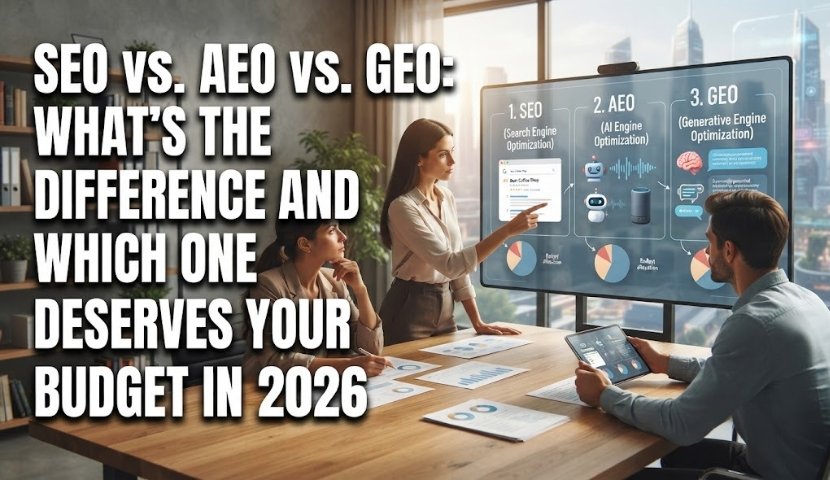
If you’ve felt lost scrolling past acronyms like AEO and GEO lately, you’re not alone. Even people who work in search marketing full-time don’t agree on exact definitions — but the underlying shift they’re describing is real, and it’s reshaping where marketing dollars need to go in 2026.
Here’s a plain-English breakdown of all three, how they’re different, and how to actually prioritize between them.
The One-Line Version
- SEO gets you found — ranking on Google or Bing so people click through to your site.
- AEO gets you answered — becoming the direct answer shown in a featured snippet, AI Overview, or voice assistant response.
- GEO gets you cited — becoming one of the sources an AI tool like ChatGPT or Perplexity pulls from and references when it generates an answer.
They’re not competing strategies. They’re three different battles for three different pieces of real estate — and increasingly, businesses need to fight all three at once.
SEO: Still About Rankings and Clicks
Traditional SEO hasn’t disappeared — Google still drives the majority of transactional, high-intent search traffic, more than any AI tool combined. If someone is actively ready to buy, they’re often still typing into Google.
What still matters here:
- Keyword-relevant content, technical site health, backlinks
- Fast load times and mobile usability
- Clear site structure Google can crawl and understand
AEO: Winning the Single Answer Slot
Answer Engine Optimization is about competing for one specific spot — the direct answer box, whether that’s a Google featured snippet, a “People Also Ask” result, or the one-line response a voice assistant reads out loud. There’s only one winner for a given query, which makes this a tighter, more competitive fight than ranking in the top 10.
What tends to win AEO:
- Short, direct, clearly-formatted answers to specific questions (FAQ blocks, definition-style openers)
- Structured data and schema markup that helps engines extract a clean answer
- Content that answers one question really well, rather than covering everything loosely
GEO: Becoming a Source the AI Trusts
Generative Engine Optimization is the newest and most misunderstood of the three. Instead of chasing a ranking or a single answer slot, GEO is about being one of the sources an AI system weaves into a longer, synthesized response — the kind you get from ChatGPT, Claude, or Perplexity when someone asks a more complex, comparison-style question.
This matters more than it might sound: recent research suggests the vast majority of B2B buyers now use AI tools somewhere in their research process, yet only a small fraction of marketing teams currently track how visible their brand is inside those AI-generated answers. That gap is where a lot of missed opportunity is hiding right now.
What tends to win GEO:
- Comprehensive, well-organized content covering a topic in depth, not just a quick answer
- Demonstrated expertise — original data, real case studies, credentialed authorship
- Consistency across your site and other sources: if AI tools see the same facts about you everywhere, they trust you more
- External validation — mentions, citations, and reviews on other credible sites
So Which One Should You Focus On?
This depends entirely on what kind of query you’re trying to win:
If the query is… | Go after… |
A specific, factual, short question (“what is X”) | AEO |
A broad, high-intent, ready-to-buy search | SEO |
A complex decision, comparison, or “which is best for me” question | GEO |
For most businesses, the practical answer in 2026 is “all three, weighted toward the queries your customers actually ask.” A software company fielding lots of comparison questions (“which CRM is best for a small agency”) should be investing heavily in GEO. A local service business fielding “near me” searches still leans hard on traditional SEO. Almost everyone benefits from picking off a few AEO wins along the way, since the content required often overlaps with both.