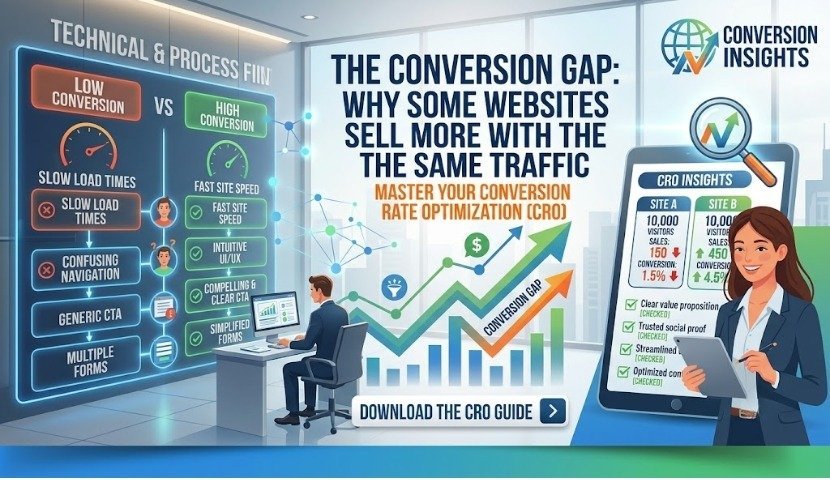
Many business owners assume that more website traffic automatically leads to more sales.
Traffic is important.
But traffic alone doesn’t determine success.
Consider two businesses:
Both receive 5,000 monthly website visitors.
One generates dozens of inquiries and sales.
The other struggles to produce meaningful results.
Why?
The answer lies in what’s known as the conversion gap.
A conversion gap occurs when a website attracts visitors but fails to turn those visitors into customers.
Understanding this gap is one of the most important steps businesses can take to improve digital performance.
Traffic Is Only Half the Equation
Many companies focus heavily on generating traffic through:
- SEO
- Social media
- Paid advertising
- Email marketing
These efforts matter.
However, if the website itself fails to convert visitors, additional traffic simply magnifies existing problems.
Increasing traffic without improving conversions can be like pouring water into a leaking bucket.
What High-Converting Websites Do Differently
Successful websites guide visitors toward action.
They answer questions, reduce uncertainty, and make decision-making easier.
Key characteristics include:
Clear Messaging
Visitors immediately understand:
- What the business offers
- Who it’s for
- Why it matters
Strong Calls-to-Action
Users know exactly what step to take next.
Trust Signals
Reviews, testimonials, certifications, and case studies build confidence.
Fast Performance
Speed helps maintain engagement and reduce abandonment.
Mobile Optimization
A seamless mobile experience supports higher conversions.
Why Visitors Leave Without Taking Action
Common reasons include:
- Confusing navigation
- Weak messaging
- Slow loading pages
- Lack of trust signals
- Complicated forms
- Poor mobile experiences
Even small obstacles can significantly impact conversion rates.
The Cost of the Conversion Gap
Many businesses focus on attracting more traffic when they should focus on maximizing existing traffic.
Improving conversions often delivers greater returns than increasing visitor numbers.
For example:
A website generating 100 leads from 10,000 visitors may outperform a website generating 20 leads from the same traffic volume.
The difference is not traffic.
It’s effectiveness.
Conversion Optimization Is an Ongoing Process
Successful websites are continuously improved through:
- User behavior analysis
- Landing page optimization
- Content improvements
- Performance enhancements
- A/B testing
- Customer feedback
Small improvements can compound over time.
Final Thoughts
The businesses winning online are not always the ones with the most traffic.
They’re often the ones converting traffic more effectively.
Closing the conversion gap can help businesses generate more leads, sales, and revenue without increasing advertising budgets.
At Chicago Tech Solutions, we help businesses identify conversion barriers, improve website performance, and create digital experiences designed to turn visitors into customers.
Frequently Asked Questions
What is a website conversion?
A conversion occurs when a visitor completes a desired action, such as submitting a form, making a purchase, or calling a business.
Why do some websites convert better than others?
Factors such as messaging, trust signals, website speed, user experience, and calls-to-action influence conversion rates.
Is increasing traffic always the best strategy?
Not necessarily. Improving conversions can often produce greater results from existing traffic.
What are trust signals?
Trust signals include reviews, testimonials, certifications, awards, and case studies that build credibility.
Can website design affect conversions?
Absolutely. User experience and design play major roles in influencing visitor behavior.