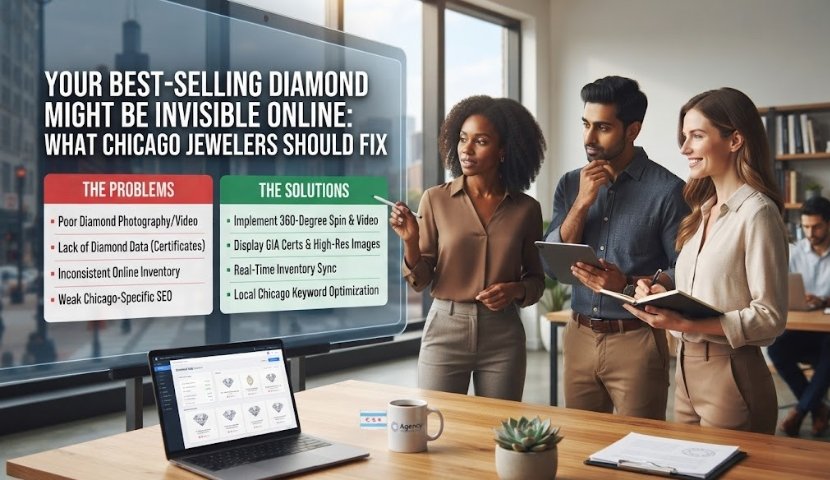
You may have the perfect diamond sitting in your Chicago showroom right now.
Beautiful cut. Incredible sparkle. Exactly the kind of engagement ring someone has been searching for.
There’s just one problem.
They may never see it.
Not because your store is difficult to find.
Not because your jewelry isn’t beautiful.
But because today’s jewelry shopping journey often begins long before someone walks through your door.
A potential customer may start on Instagram.
Then they search Google.
They visit your website.
They look through photos.
They check reviews.
They compare you with other Chicago jewelers.
They watch a few videos.
They may even use an AI-powered search tool to research diamonds, engagement rings, or local jewelers.
By the time they contact a store, they’ve already formed an opinion.
For Chicago jewelry businesses, your digital presence is becoming an extension of your showroom.
And if your best jewelry is difficult to discover online, you’re giving competitors an opportunity to get noticed first.
Chicago Jewelers Have a Digital Showroom Problem
Walk into a great jewelry store and everything is intentional.
The lighting.
The displays.
The glass.
The presentation.
The packaging.
The conversation.
The way a diamond is placed in front of the customer.
Then look at some jewelry businesses online.
The experience changes completely.
The website feels dated.
Instagram hasn’t been updated consistently.
Product photos don’t capture the jewelry properly.
The Google Business Profile has limited information.
The website says very little about engagement rings, custom jewelry, repairs, or other services.
There’s no video.
There’s no story.
There’s no obvious reason to choose that jeweler over another one.
That’s a disconnect.
If the in-store experience feels premium, the online experience should too.
Your Website Is Your Showroom After Hours
Your physical store eventually closes.
Your website doesn’t.
Someone could be looking for an engagement ring from their couch late at night.
Another customer may be researching a custom jeweler during lunch.
Someone else may be comparing Chicago jewelry stores before deciding where to spend Saturday afternoon.
Your website is meeting these people before you do.
Ask yourself:
Does it represent the quality of your jewelry?
Does it feel trustworthy?
Does it work beautifully on a phone?
Can customers quickly understand what you specialize in?
Can they see your collections or craftsmanship?
Can they find your Chicago location?
Can they request an appointment?
If the answer is no, the website isn’t simply outdated.
It may be creating friction between discovery and the showroom visit.
If Your Jewelry Looks Better in Person Than Online, Fix the Visuals
Jewelry is one of the worst products to photograph badly.
A stunning diamond can look ordinary under poor lighting.
Gold can lose its warmth.
Details disappear.
Gemstones can look flat.
And a luxury product can suddenly feel inexpensive.
Chicago jewelers should treat photography and video as part of the sales experience.
Customers want to see the sparkle.
Show movement.
Show close-ups.
Show the ring on a hand.
Show different angles.
Show craftsmanship.
Show packaging.
Show what happens when natural light hits the stone.
Professional visuals don’t replace seeing jewelry in person.
They give customers a reason to want to see it in person.
Before They Enter Your Store, They May Enter Your Instagram
For a visual business like jewelry, Instagram can become a second showroom.
But many jewelry businesses use it like an inventory board:
Ring.
Ring.
Necklace.
Ring.
Sale.
Ring.
That’s not much of a story.
A stronger social media marketing strategy for jewelers combines products with people, expertise, emotion, education, and behind-the-scenes content.
Instead of only posting a diamond, explain it.
Instead of only showing an engagement ring, tell the story behind the design.
Instead of saying:
“Beautiful custom engagement ring. DM for details.”
Try:
“He came in with a photo she’d saved months ago. We used it as inspiration and created something entirely hers.”
Now the product has emotion.
That’s what jewelry marketing needs.
One Engagement Ring Can Create a Week of Social Content
Chicago jewelry businesses don’t necessarily need more products to create more content.
They need to document the products they already have more strategically.
One custom engagement ring could become content showing:
- The original inspiration
- Diamond selection
- Design or sketch
- Setting choice
- Behind-the-scenes craftsmanship
- Macro details
- Finished ring reveal
- Jeweler explaining the piece
- Customer story with permission
- Website portfolio feature
That’s how one sale can become an entire content story.
And because the content is based on your actual work, it becomes much harder for competitors to copy authentically.
Put the Chicago Jeweler on Camera
Jewelry customers have questions.
Lots of them.
And those questions are content opportunities.
Your jeweler could answer:
“Natural diamond or lab-grown?”
“What’s the difference between cut and clarity?”
“How do I secretly find my partner’s ring size?”
“What should I look for when comparing two diamonds?”
“Can we redesign a family heirloom?”
“Yellow gold, white gold, or platinum?”
“How do I choose an engagement ring she’ll actually love?”
“What makes one diamond sparkle more than another?”
“How should I care for my engagement ring?”
These videos don’t need complicated production.
A knowledgeable person, a beautiful piece of jewelry, good lighting, clear audio, and a useful answer can be enough.
The goal isn’t to make your jeweler an influencer.
It’s to make their expertise visible.
Chicago Is Part of Your Marketing Advantage
A Chicago jeweler shouldn’t look like a random jewelry account that could be located anywhere.
Being local matters.
Show it.
Talk about Chicago.
Show your showroom.
Introduce your team.
Feature local customer stories when permission is given.
Create proposal-related content connected to Chicago.
Talk about bridal shopping.
Highlight local events or partnerships when relevant.
If your store serves customers from areas such as the Loop, River North, Gold Coast, Lincoln Park, Lakeview, West Loop, or surrounding suburbs, create genuinely useful content for those audiences where appropriate.
Don’t simply insert “Chicago jeweler” into every paragraph.
Demonstrate that you’re actually part of the market.
That’s better for customers and better for local marketing.
Your Google Business Profile Shouldn’t Be an Afterthought
For a local jewelry store, Google can become a major part of the buying journey.
A potential customer may search for things like:
jewelry store near me
jeweler in Chicago
engagement rings Chicago
custom jeweler Chicago
jewelry repair Chicago
Then they start comparing.
Photos.
Reviews.
Business information.
Location.
Website.
Services.
Overall presentation.
Your Google Business Profile should accurately reflect the business customers will experience when they arrive.
Keep your information current.
Use strong original photos.
Clearly describe the services you genuinely offer.
Respond professionally to reviews.
Connect customers to a useful website.
Local SEO isn’t about stuffing “near me” into every sentence.
It’s about making your business easier to understand and discover when relevant local customers are searching.
Your Reviews Are Marketing Content
Imagine a customer writes:
“They helped me create a custom engagement ring from my grandmother’s original diamond.”
That’s more than a review.
It’s a story.
With the customer’s permission, that story could become:
A social post.
A Reel.
A website testimonial.
A custom jewelry case study.
A Google Business Profile update.
The review provides something your own advertising can’t manufacture as convincingly:
another customer’s perspective.
Don’t hide your strongest reviews on one page of your website.
Use them thoughtfully throughout the customer journey.
Your Website Needs More Than a Homepage
If you offer multiple jewelry categories and services, one generic page may not provide customers with enough information.
A Chicago jewelry website might need dedicated pages for the areas that genuinely apply to the business, such as:
Engagement Rings
Wedding Bands
Custom Jewelry
Diamond Jewelry
Fine Jewelry
Jewelry Repair
Jewelry Restoration
Jewelry Appraisals
Bracelets
Necklaces
Earrings
Gemstone Jewelry
Each important service or category deserves enough information for customers to understand what you offer and what makes your approach different.
This also gives search engines clearer context about your business.
Don’t Forget the People Who Aren’t Ready to Buy Yet
Not everyone visiting your website today is ready to purchase a diamond today.
That’s normal.
An engagement-ring shopper may research for weeks or months.
Give them useful information.
Create articles such as:
How to Choose an Engagement Ring
Natural vs. Lab-Grown Diamonds: What Should You Consider?
Diamond Shapes Explained
How to Choose a Wedding Band That Complements an Engagement Ring
What to Know Before Designing a Custom Engagement Ring
How to Care for Fine Jewelry
Questions to Ask a Jeweler Before Buying a Diamond
Helpful content allows your business to enter the customer’s journey earlier.
When they’re finally ready to make an appointment, your brand is no longer a stranger.
Your Website Should Make Appointments Easy
Imagine someone has spent twenty minutes looking at your rings.
They’re interested.
Then they decide to schedule a consultation.
Don’t make them hunt for the next step.
Use clear calls to action such as:
Schedule a Consultation
Book an Appointment
Visit Our Showroom
Ask About This Piece
Start Your Custom Design
Speak With a Jeweler
The right CTA depends on your business model.
But the next step should always be obvious.
Mobile Experience Matters More Than the Owner’s Desktop
Your website may look fantastic on the computer in your office.
That’s not enough.
Your customer may have discovered you while scrolling on their phone.
They tap your Instagram profile.
They visit the website.
If text is tiny, images load slowly, navigation is frustrating, or appointment forms are difficult to complete, you’ve created unnecessary friction.
For jewelry brands, mobile presentation is especially important because the product needs to remain visually impressive on a smaller screen.
Your digital showroom needs to fit in someone’s hand.
Social Media and Website Design Should Look Like the Same Brand
Imagine your Instagram feels luxurious and modern.
Then your website looks ten years older.
Or your website is elegant, but social media is filled with inconsistent graphics and low-quality photos.
Customers notice the disconnect.
Your visual identity should carry across:
Website.
Instagram.
Facebook.
Google Business Profile.
Video.
Email.
Digital advertising.
Packaging.
In-store materials.
You don’t need every platform to look identical.
But customers should recognize the same business.
Don’t Make Every Post “Buy Now”
Jewelry is often a considered purchase.
Trust matters.
Education matters.
Emotion matters.
So build content around different stages of the customer’s journey.
Some posts should create desire.
Some should answer questions.
Some should show expertise.
Some should demonstrate craftsmanship.
Some should build local familiarity.
Some should feature customer experiences.
And yes, some should ask for the sale or appointment.
A feed made entirely of promotions can quickly become easy to ignore.
The Biggest Jewelry Marketing Opportunity May Be Video
Jewelry wants to move.
A photograph freezes the sparkle.
Video lets customers experience it.
Consider short-form videos around:
Ring reveals
Diamond comparisons
Jeweler Q&As
Custom design transformations
Jewelry cleaning
Behind-the-scenes work
New arrivals
“Which would you choose?” comparisons
Customer stories
Jeweler reacts
Engagement ring education
One strong video can also be adapted for Instagram, Facebook, YouTube Shorts, your website, and other appropriate channels.
Capture once.
Use strategically.
What About AI Search?
Search behavior continues to evolve as consumers use traditional search engines alongside AI-powered discovery and research tools.
A customer may ask detailed questions about diamonds, engagement rings, jewelry care, or choosing a trustworthy jeweler.
That makes clear, useful website content increasingly valuable.
But there is no secret button that guarantees your jewelry business will appear in an AI-generated answer.
Focus on fundamentals that also make the business easier for humans to evaluate:
Publish original expertise.
Answer real customer questions.
Clearly identify your business and services.
Keep location and contact information consistent.
Create strong service and product-category pages.
Publish original photos and videos.
Show real experience.
Earn legitimate reviews and mentions.
Use structured data appropriately.
Make important website content accessible to search engines.
The objective isn’t to write strange content for AI.
It’s to make your business easy to understand and worth referencing.
A Beautiful Website Won’t Help If Nobody Finds It
Design matters enormously for jewelry.
But design and discoverability need to work together.
A jewelry website should combine:
Branding + User Experience + SEO + Local SEO + Content + Conversion
The website needs to look good.
It also needs to clearly communicate what you sell, where you’re located, why customers should trust you, and what they should do next.
That’s the difference between having a website and having a digital marketing asset.
The “Invisible Diamond Test” for Chicago Jewelers
Open your phone and look at your jewelry business like a customer who has never heard of you.
Search your important products and services.
Find your business on Google.
Open your website.
Visit your Instagram.
Look at your reviews.
Then ask:
Would I trust this business with an important jewelry purchase?
Can I immediately see what makes it different?
Do the photos make the jewelry desirable?
Does the website feel as premium as the showroom?
Can I easily find the products or services I need?
Can I tell where the business is located?
Can I book or contact someone without friction?
Does social media look active and human?
Can I see genuine expertise?
Every “no” is a potential improvement.
Frequently Asked Questions
Does a Chicago jewelry store really need social media?
For many jewelry businesses, social media provides a valuable way to showcase products, demonstrate expertise, tell customer stories, build familiarity, and stay visible during a customer’s research process. The right platforms depend on the audience and business model.
What social media platform is best for jewelers?
Instagram is a natural fit because jewelry is highly visual, but the best mix depends on the target customer. Facebook, YouTube, Pinterest, TikTok, and other platforms may also support different goals.
What should Chicago jewelers post on Instagram?
Try engagement-ring reveals, custom-design journeys, diamond education, jewelry-care advice, new arrivals, customer stories, comparisons, behind-the-scenes craftsmanship, staff videos, and locally relevant content.
Does a jewelry business need a professional website?
A professional website can help communicate trust, showcase products and services, support search visibility, provide educational information, and give potential customers a clear path toward an appointment, inquiry, showroom visit, or online purchase.
Can SEO help a local jewelry store?
SEO and Local SEO can improve a website’s ability to compete for relevant search visibility. Results depend on many factors, including competition, website quality, relevance, location, authority, and the strength of the overall search strategy.
How important are Google reviews for jewelers?
Reviews can play an important role in customer trust and local discovery. Jewelry purchases can involve significant emotion and consideration, making authentic customer experiences particularly valuable.
Should jewelry stores create Reels?
Short-form video is especially useful for showing sparkle, movement, craftsmanship, transformations, comparisons, and the people behind the business.